
Perimenopause and Hair Loss: Why Your Brush Is Suddenly Full
Perimenopause and hair loss can overlap in confusing ways. Learn why shedding may change, what else to rule out, and how to talk with your provider.
Perimenopause and Hair Loss: Why Your Brush Is Suddenly Full
You are not being ridiculous for noticing the hair in the drain.
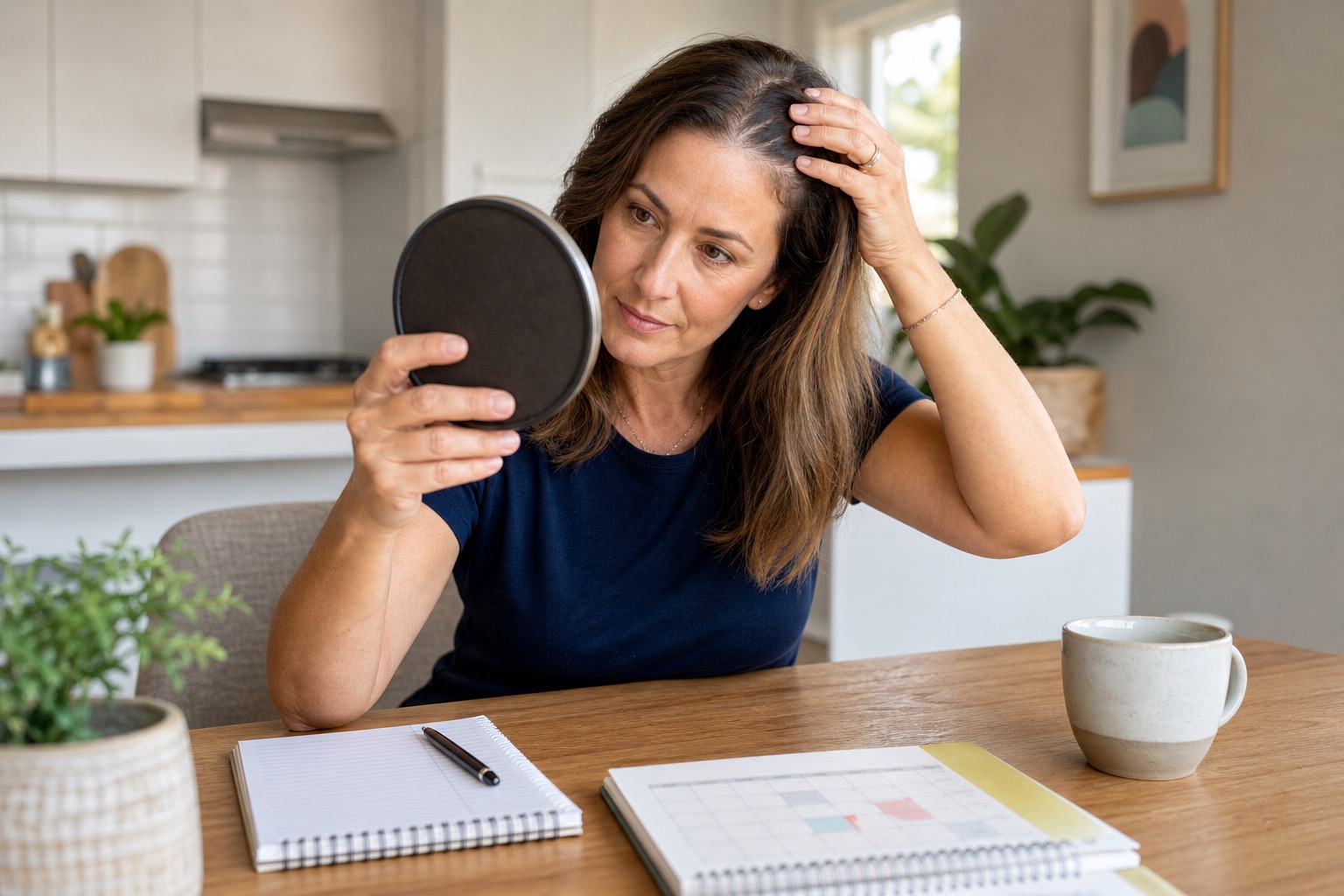
If you searched perimenopause and hair loss, I am guessing something changed. Your ponytail feels thinner. Your part looks wider in the bathroom mirror. The shower floor is staging a tiny rebellion. Maybe you keep telling yourself it is probably nothing, then checking your scalp under increasingly unflattering lighting.
Fun little hobby, said no woman ever.
Let me be clear: hair loss can have many causes, and some deserve medical evaluation. But hormonal change can absolutely be part of the conversation, especially in your late 30s and 40s when other perimenopause symptoms may be showing up too.
This article is educational, not medical advice. I am not a doctor. I can help you understand the common patterns, what to track, and what to ask your healthcare provider so you are not left alone with a brush full of evidence and a head full of panic.
Can Perimenopause Cause Hair Loss?
Perimenopause can contribute to hair changes for some women, yes.
That does not mean every strand in the sink is caused by estrogen. Hair is dramatic, but it is not simple.
The American Academy of Dermatology describes female pattern hair loss as the most common cause of hair loss in women, often beginning in midlife. Healthdirect notes that female pattern hair loss is more common after menopause and that nearly half of females show signs of hair loss by age 50. Women’s Health Concern, the patient arm of the British Menopause Society, also lists menopausal hair loss as a real concern and emphasizes checking for other triggers and medical causes.
Here’s the thing: your hair follicles are hormone sensitive. During perimenopause, estrogen and progesterone fluctuate before eventually declining. Those shifts can change the balance between estrogen’s effects and androgens, the group of hormones often talked about in pattern hair loss.
Plain English? The same hormonal transition that can mess with sleep, mood, periods, joints, skin, and temperature regulation may also affect hair growth cycles.
Not because you are vain.
Because hair is biology.
What Perimenopause Hair Loss Can Look Like
Hormone-related hair changes do not always look like dramatic bald spots.
Many women notice quieter clues first:
- A widening part
- A thinner ponytail
- More scalp showing at the crown
- Extra shedding in the shower or brush
- Hair that feels finer or less dense
- A receding look around the temples
- More breakage, especially if the hair is dry or fragile
Female pattern hair loss usually looks different from the classic male-pattern bald spot. The AAD describes thinning mainly on the top of the scalp, often starting with a wider center part. Healthdirect describes thinning across the scalp, usually beginning at the parting, while the scalp itself looks normal.
One woman I interviewed, “Dana,” 44, told me she noticed it in photos first.
“I kept thinking the lighting was bad. Then I realized every photo showed the same thing: my part looked wider. I wasn’t losing clumps. It was just slowly less hair than I was used to.”
That slow, “am I imagining this?” quality is exactly why women second-guess themselves.
You are allowed to notice.
Why Hair Changes During Perimenopause Can Feel So Personal
Hair is not medically more important than sleep, bleeding changes, chest symptoms, mood shifts, or pain.
But emotionally? Hair can hit hard.
It is visible. It changes how you recognize yourself. It can feel like one more piece of evidence that your body is changing without permission. And if you have already been dismissed about perimenopause symptoms at 45, hair loss can feel too “cosmetic” to bring up without being brushed off.
Bring it up anyway.
Hair loss can affect quality of life, and it can point to treatable issues. It can be related to genetics, hormones, thyroid disease, iron deficiency, stress, illness, medication effects, scalp conditions, autoimmune hair loss, nutrition changes, rapid weight changes, postpartum shifts, or hairstyles that pull on the hair.
Hormones may be one thread in the story.
They should not be used as a trash can where every symptom goes when nobody wants to investigate.
What Else Can Cause Hair Loss Around 40?
This is the section that keeps us honest.
Perimenopause might be involved. So might something else. Sometimes both are true at the same time, because apparently midlife did not get the memo about keeping mysteries tidy.
Common contributors to discuss with a clinician include:
- Female pattern hair loss, which often runs in families and tends to show up as gradual thinning
- Telogen effluvium, a temporary shedding shift that can follow illness, intense stress, surgery, weight loss, childbirth, or major life strain
- Thyroid problems, which can affect hair growth and shedding
- Low iron or low ferritin, especially if periods are heavy or erratic
- Vitamin or nutrition issues, including restrictive dieting or absorption problems
- Scalp conditions, such as psoriasis, seborrheic dermatitis, fungal infection, or inflammation
- Alopecia areata, an autoimmune condition that can cause patchy hair loss
- Medication effects, including some drugs used for blood pressure, mood, hormones, acne, or other conditions
- Hair practices, especially tight styles, extensions, harsh processing, heat, or repeated tension
This is why “just take a hair vitamin” is not a plan.
The AAD warns that supplements marketed for hair growth can backfire if you get too much of certain nutrients. More is not always better. More is sometimes just expensive urine with a side of regret.
If you are thinking about supplements, talk with your provider first, especially if you take medications, have thyroid issues, are pregnant or trying to conceive, or have a medical condition.
What To Track Before Your Appointment
You do not need a perfect spreadsheet. You need enough information to make the pattern harder to dismiss.
For two to four weeks, jot down:
- When you first noticed the shedding or thinning
- Whether it is gradual thinning, sudden shedding, patchy loss, or breakage
- Where you notice it: part, crown, temples, hairline, whole scalp, eyebrows, lashes
- Any scalp symptoms: itching, burning, flaking, redness, pain, sores
- Period changes, hot flashes, night sweats, sleep disruption, mood shifts, or other unusual perimenopause symptoms
- Recent illness, surgery, high stress, rapid weight change, new diet, or major life event
- Heavy periods or bleeding changes
- New medications, supplements, hormone changes, or stopping birth control
- Family history of hair thinning
- Hair practices that involve tension, heat, bleaching, extensions, or tight styles
You can also take the least glamorous progress photos known to humanity: same bathroom, same lighting, same angle, once every few weeks. Do not do this daily unless you enjoy tormenting yourself with fluorescent-lit scalp analysis.
Once a week is enough.
When Hair Loss Needs Medical Attention
Talk to your healthcare provider or a dermatologist if the hair loss worries you, changes quickly, comes with scalp symptoms, or affects your quality of life.
Please do not wait it out if you notice:
- Sudden heavy shedding
- Round or patchy bald spots
- Scalp pain, burning, redness, sores, scaling, or significant itching
- Hair loss with fatigue, cold intolerance, dizziness, shortness of breath, weight changes, or other systemic symptoms
- New acne, facial hair growth, voice changes, or cycle changes that could suggest higher androgen levels
- Hair loss after starting or changing medication
- Hair loss plus very heavy or irregular bleeding
- Eyebrow or eyelash loss
Healthdirect notes that doctors can often diagnose the cause by asking about symptoms and examining the scalp, and may use blood tests or other testing when the cause is unclear. That is the point: evaluation first, guessing second.
What Can Help With Perimenopause Hair Loss?
There are options, but the right one depends on the cause.
For female pattern hair loss, dermatologists may discuss treatments such as topical minoxidil or prescription medications in specific situations. For shedding related to low iron, thyroid disease, scalp inflammation, illness, or medication effects, the answer may be very different.
So the safest first move is not to buy seven serums at midnight.
It is to get clear on what type of hair loss you are dealing with.
Try this language:
“I am noticing more shedding and a wider part. I am also having possible perimenopause symptoms. Can we evaluate common causes of hair loss, including thyroid issues, iron/ferritin, medication effects, scalp conditions, and female pattern hair loss?”
If you are dismissed with “that’s just aging,” you can ask:
“What findings make you confident this does not need evaluation, and what should I watch for that would change the plan?”
Calm. Specific. Annoyingly reasonable.

The Bottom Line on Perimenopause and Hair Loss
Perimenopause and hair loss can overlap. Hormone shifts may contribute to thinning, shedding, texture changes, and that unsettling “my hair is not acting like my hair” feeling.
But hair loss is not automatically perimenopause. It is worth checking because some causes are treatable, and because you deserve more than a shrug.
If this symptom is one piece of a larger pattern, the deeper context matters. I cover the bigger “what is happening to my body?” picture in Not Crazy, Just Hormones, including how to track symptoms, talk to providers, and stop treating scattered clues like separate personal failures.
Your hair is allowed to matter.
So is the woman attached to it.
References
- American Academy of Dermatology Association. “Thinning hair and hair loss: Could it be female pattern hair loss?”
- American Academy of Dermatology Association. “Hair loss: Tips for managing.”
- Healthdirect Australia. “Female pattern hair loss.”
- Healthdirect Australia. “Alopecia (Hair loss).”
- Women’s Health Concern/British Menopause Society. “Menopausal Hair Loss.” Reviewed November 2025.