
Perimenopause Diet Plan Without Panic, Shame, or Weird Food Rules
Looking for a perimenopause diet plan? Start with food that supports your real life, not rigid rules or promises to fix your hormones.
Perimenopause Diet Plan Without Panic, Shame, or Weird Food Rules
If you have searched for a perimenopause diet plan, you have probably met the internet’s favorite hobby: turning a body change into a grocery list with seventeen rules, two forbidden fruits, and a woman in beige telling you to “reset.”
Nope.
Food can be part of taking care of yourself during perimenopause. It can support your overall health, give you steadier energy, and make daily life feel less like a scavenger hunt for whatever is closest to your hand at 4 p.m. But it cannot guarantee that hot flashes will disappear, make fluctuating hormones behave, or prove why you are tired, anxious, gaining weight, or not sleeping. Your body is not failing because it did not respond to a seed-cycling chart.
Here is the thing: a useful perimenopause diet plan should give you more information and less shame. It should make room for your budget, your culture, your schedule, your appetite, and the fact that some weeks you are feeding other people while trying to remember whether you already made coffee.
A quick note before we start: This article is educational, not medical advice. I am not a doctor, and food cannot diagnose or treat symptoms on its own. Please discuss major diet changes, unexplained symptoms, weight changes, medications, or supplements with a qualified healthcare provider who knows your history.
Why perimenopause diet advice gets so weird so fast
Perimenopause is a transition, not a personal failure with a garnish of spinach. Estrogen can fluctuate during these years, and symptoms and cycle changes vary widely from person to person. ACOG’s menopause guidance is a useful reminder that there is no one tidy symptom list or timetable.
That uncertainty creates a very welcoming environment for confident promises. “Balance your hormones.” “Fix menopause weight gain.” “Never eat this after 40.” The claims are usually much more certain than the evidence.
The American College of Obstetricians and Gynecologists (ACOG) says that eating a balanced diet can support health before, during, and after menopause. That is a solid, sensible idea. It is not the same as saying there is one best diet for every person in perimenopause, or that a particular food plan is a treatment. ACOG’s menopause guidance puts nutrition alongside exercise and routine care as part of healthy midlife, not as a replacement for individualized medical care.
And honestly? That distinction is a relief. You do not need to perform a perfect diet to deserve answers about your symptoms.
A calmer answer to “can diet help perimenopause symptoms?”
Can diet help perimenopause symptoms? It may help you feel more supported in the day-to-day sense, especially when regular meals, adequate nourishment, and foods you enjoy make energy or digestion more predictable. But a meal plan cannot tell you whether a new symptom is perimenopause, stress, a medication effect, another health condition, or several things layered together.
That does not make food irrelevant. It makes it one lane, not the whole highway.
Think less about a perfection plan and more about a few questions:
- Am I eating often enough to get through my actual day? Skipping breakfast because mornings are chaos and then becoming furious at a printer by noon is not a moral flaw. It is useful information.
- Do I have foods around that feel filling and workable? “Workable” counts. A bagged salad, canned beans, frozen vegetables, leftovers, toast, yogurt, rice, eggs, soup, or takeout can all belong in a real life.
- Are there patterns worth noticing, without making them a diagnosis? You might jot down whether alcohol, caffeine, large late meals, long gaps without food, or certain foods seem connected to sleep, reflux, hot flashes, or digestion. A pattern is something to discuss, not proof that you have solved the case.
- Has food become another source of stress? If rules around eating are making you anxious, isolated, or afraid of ordinary meals, that deserves compassion and support too.
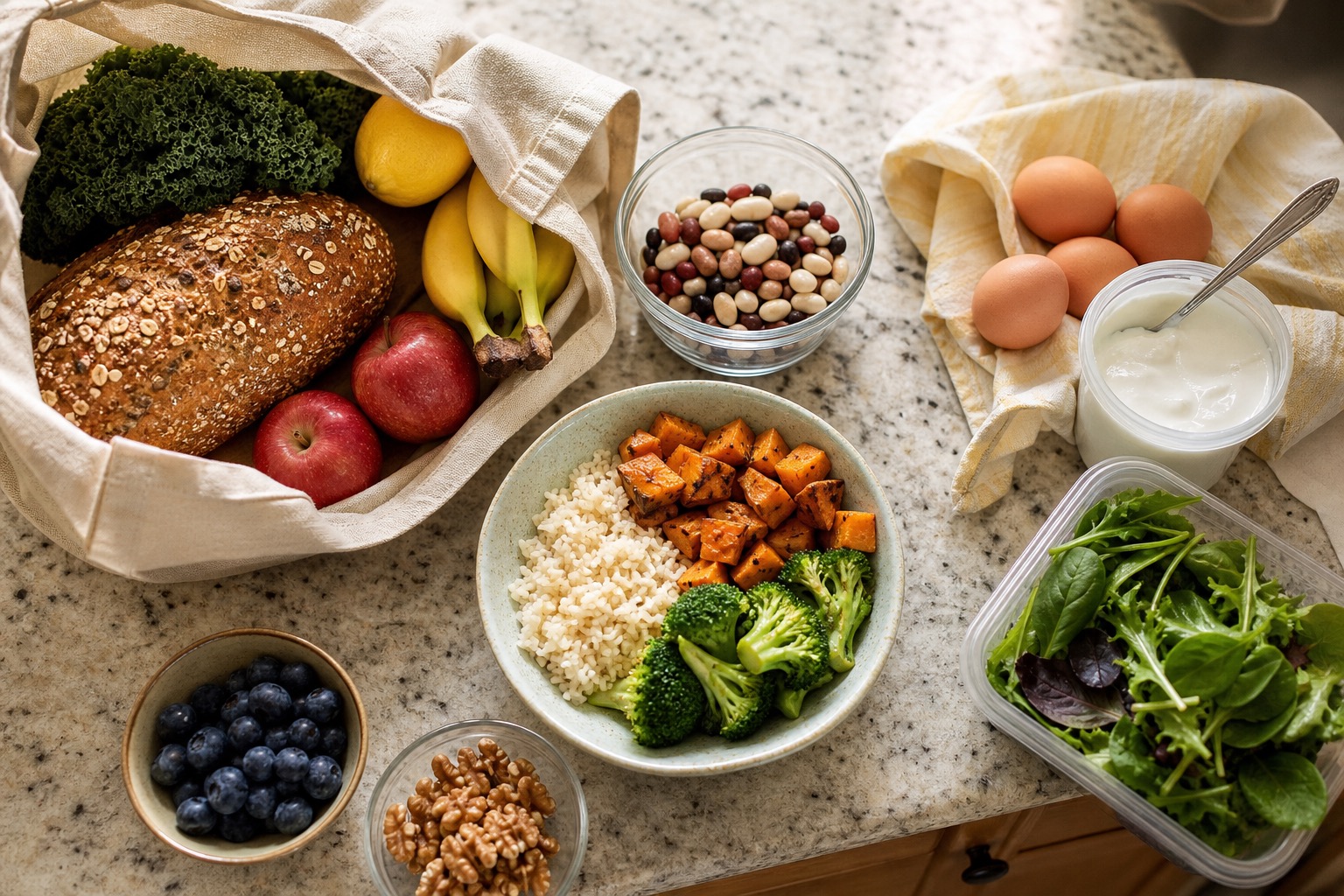
Build meals around support, not punishment
You do not need a prescription from a blog post. But it can be useful to build a short list of meals and snacks that help you feel fed, are available when you need them, and do not require a cooking show audition.
For many people, that may mean combining foods that offer protein, carbohydrates, fats, and fiber across the day. It may mean adding something rather than starting with a ban: fruit next to the toast, beans in the soup, yogurt with the cereal, a handful of nuts with the afternoon snack. The details will depend on your preferences, access, allergies, digestive needs, cultural foods, and medical history.
ACOG specifically notes that a balanced diet, including enough calcium and vitamin D, supports health in midlife. That is a worthwhile topic for a clinician or registered dietitian if you have questions about your own needs. It is not an invitation for me to hand you supplement doses or tell you that a single “bone health” smoothie has saved the day. Smoothies have enough pressure already.
What matters most is that the plan can survive a hard Wednesday. A plan that works only when you have extra money, perfect sleep, and a farmers market within walking distance is not a plan. It is a lifestyle photo shoot.
Perimenopause weight gain is not a character report card
The phrase “best diet for perimenopause weight gain” carries a lot of fear in a very small package. Bodies can change in midlife for many reasons, including aging, activity, sleep, stress, medications, health conditions, and the hormonal transition itself. You do not need to decide which one is responsible by staring at your lunch.
If weight change is bothering you, bring it up. You are allowed to ask for a conversation that looks at the whole picture, rather than getting handed a generic instruction to “eat less and move more.” A provider can help decide what should be evaluated and whether referrals, medication review, nutrition support, or other care make sense for you.
And please do not ignore new, unexplained, rapid, or concerning changes because an influencer told you that everyone gains weight in perimenopause. Perimenopause can be part of the picture; it should not become a catch-all explanation. Our article on normal labs and perimenopause symptoms explains why both your symptoms and a fuller assessment deserve attention.
A two-week notes experiment, not a food trial
If you want to know whether food is affecting how you feel, try collecting gentle clues for a week or two. Not a calorie ledger. Not a court case against yourself. Just a few notes you could bring to a real conversation.
You might record:
- When you ate and whether you felt satisfied afterward
- Sleep, energy, digestion, hot flashes, or mood changes that disrupted your day
- Cycle changes, if you are tracking them
- Alcohol, caffeine, new supplements, medication changes, illnesses, travel, or unusually stressful weeks
- The question you most want answered
This makes the provider conversation more specific without pretending you can interpret the data alone. Tracking perimenopause symptoms can help you focus on patterns that are useful to share. The free perimenopause symptom tracker is there for the same reason: better notes, better conversation, fewer moments of sitting on crinkly paper wondering why your brain has left the building.

What to ask if you want nutrition support
You do not have to arrive with a perfect food diary or a demand for a particular diet. You can start here:
“I am seeing a lot of perimenopause diet advice online, and I want help sorting out what is reasonable for my health. Could we talk about my symptoms, any changes I have noticed, and whether nutrition support or a registered dietitian would be useful?”
That question leaves room for the things a responsible conversation should include: your symptoms, your medical history, your medicines and supplements, your goals, and what is realistic in your life. NICE’s menopause guideline emphasizes individualised discussion of management options and personal circumstances. That is the standard to look for, even when the topic is food. Read the NICE guidance.
If an appointment has left you feeling waved off, our guide to talking to your doctor about perimenopause can help you bring a short agenda and ask for clearer next steps. Food advice should never be used as a polite way to end the conversation.
Keep the goal small enough to live with
A good food plan is not a referendum on your body. It might be as simple as making breakfast less chaotic, adding a few easy dinners to the rotation, or asking for help because digestion, appetite, sleep, or weight changes feel different than they used to.
You deserve care that is more useful than “cut carbs” and more humane than “just love your body” while nobody asks what is actually going on. Food can be supportive. Your questions are valid. And you do not have to fix your hormones with lunch.
If you want more plain-English backup before a provider visit, read a free chapter of Not Crazy, Just Hormones. For the bigger picture on sorting evidence from hype and getting a care conversation that fits your life, the book is waiting when you are ready.
Want less wellness noise and better questions?
Not Crazy, Just Hormones offers symptom context, provider-question scripts, and grounded support for women who are tired of being talked down to.
This article is for educational purposes only and is not medical advice. Evelyn Cale is not a medical professional. Please discuss nutrition changes, symptoms, supplements, medications, and treatment decisions with a qualified healthcare provider who knows your history. Seek prompt medical care for new, severe, persistent, worsening, rapid, or concerning symptoms.
References
- American College of Obstetricians and Gynecologists. The Menopause Years.
- National Institute for Health and Care Excellence. Menopause: identification and management (NG23).