Perimenopause Heart Palpitations: Scary, Common, and Still Worth Checking
Perimenopause heart palpitations can feel terrifying, especially when they show up at night or alongside anxiety. Here's what may be hormonal, what else to rule out, and what to say to your provider.
Perimenopause Heart Palpitations: Scary, Common, and Still Worth Checking
There are symptoms that are annoying.
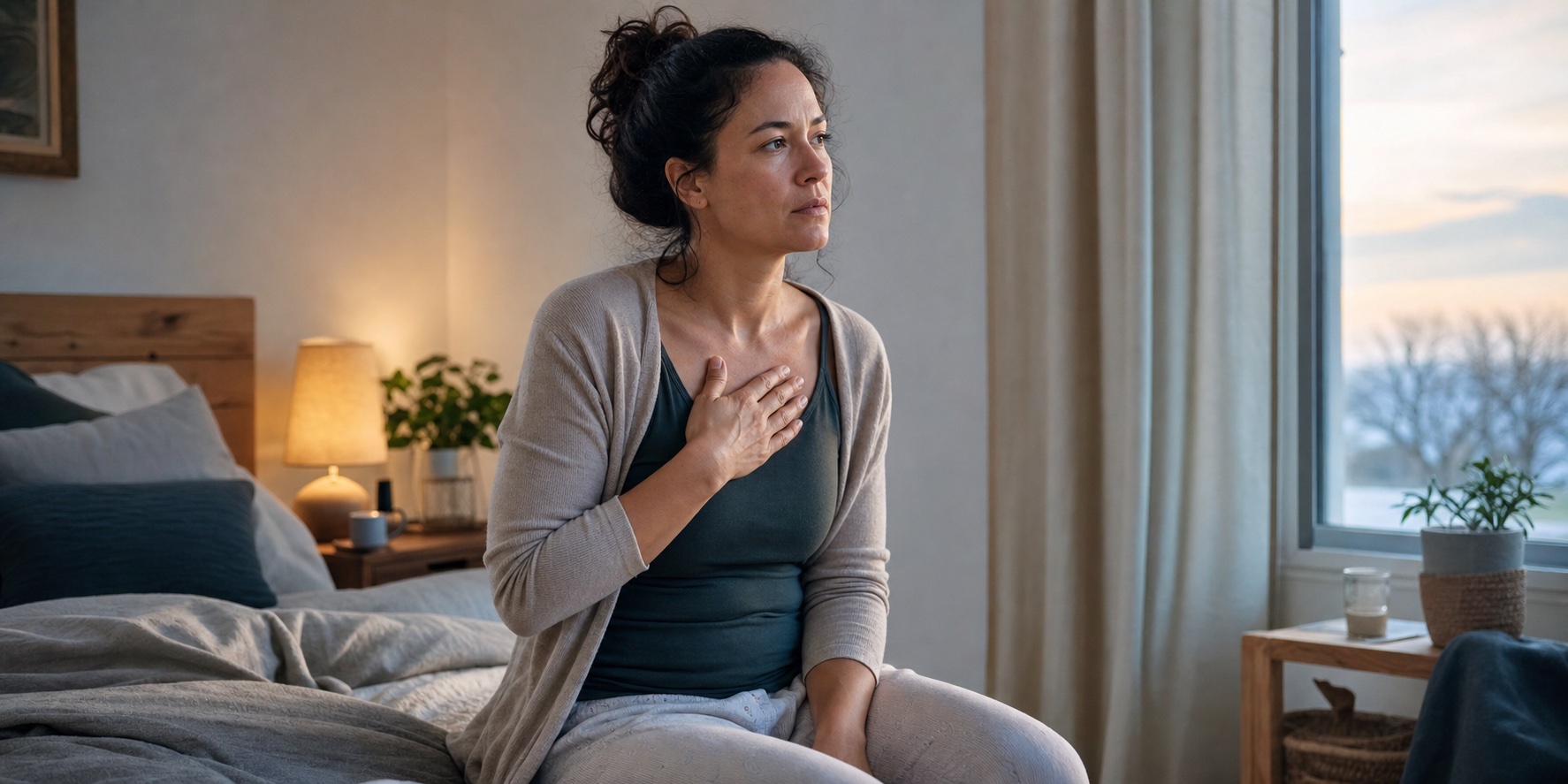
And then there are symptoms that make you sit bolt upright in bed at 2:14 a.m. with one hand on your chest, wondering whether your heart is trying to send you a message in Morse code.
Heart palpitations fall into the second category.
Maybe it feels like fluttering. Maybe your heart suddenly pounds for ten seconds and then goes back to normal like nothing happened. Maybe it races at night, right when the house is quiet and your brain has nothing better to do than start composing your medical obituary.
Let me be clear: perimenopause heart palpitations can be real. They can also be scary enough that they deserve a proper medical check. Both things can be true.
This is not the article where I tell you, “Oh, it’s probably hormones, don’t worry about it.” Absolutely not. Your heart is not a casual footnote. But this is also not the article where I turn every flutter into a catastrophe.
Here’s the steadier truth: hormone shifts can make palpitations more likely, especially when they show up with hot flashes, night sweats, poor sleep, and anxiety. But new, frequent, severe, or concerning heart symptoms should be discussed with a qualified healthcare provider so the real cause can be sorted out.
You’re not being dramatic. You’re paying attention.
What Heart Palpitations Can Feel Like
The NHS describes heart palpitations as an uncomfortable or unusual awareness of your heartbeat. You might feel it in your chest, throat, or neck. It may feel like racing, pounding, fluttering, skipped beats, or extra beats.
Very elegant, this human body. Very normal to suddenly become aware that you have a heart and would prefer it not improvise.
Women describe palpitations in all kinds of ways:
- A sudden thump or flip in the chest
- A fluttery feeling, like a little electrical hiccup behind the ribs
- A racing heart while lying still
- A skipped beat followed by a stronger beat
- A pounding pulse in the neck or throat
- A heart-racing feeling during a hot flash or night sweat
- A wave of anxiety that arrives with the heartbeat change
One woman I interviewed, “Dana,” 43, told me she first noticed it while reading in bed.
“I was completely still, not stressed, not exercising, and suddenly my heart started banging like I had run upstairs. By the time it stopped, I was shaking because I couldn’t tell whether the panic caused the heart racing or the heart racing caused the panic.”
That loop is brutal. Palpitations can trigger fear. Fear can make your heart beat faster. Then the faster heartbeat feels like proof that something is wrong.
And there you are, wide awake, Googling “heart flutter perimenopause or death spiral” with one eye open.
Can Perimenopause Cause Heart Palpitations?
It can.
The NHS lists menopause as one possible cause of palpitations, while making the important point that other causes can include anemia, thyroid problems, heart rhythm issues, medications, caffeine, alcohol, stress, and lack of sleep.
That’s the part we have to hold carefully: perimenopause can be part of the explanation, but it should not become the automatic explanation for every heart symptom.
During perimenopause, estrogen and progesterone don’t politely decline in a straight line. They swing around. They rise, fall, spike, and dip. Those shifts can affect the nervous system, sleep, temperature regulation, mood, and possibly the way your body experiences heart rhythm changes.
Palpitations also seem to travel with other perimenopause symptoms. A 2022 scoping review on palpitations during menopause found likely links with worse vasomotor symptoms, worse sleep, lower physical activity, and worse quality of life, while also noting that the evidence is still sparse. A SWAN-based study later found that roughly half of women followed a moderate or high probability palpitation pattern through perimenopause into early postmenopause.
Translation: plenty of women report this. The research is catching up. Your doctor should not look at you like you just described a haunted toaster.

Why They Often Show Up at Night
Nighttime palpitations are especially rude.
During the day, you can be distracted. There are meetings, dishes, errands, children asking where the scissors are even though nobody in your house has seen scissors since 2019.
At night, everything gets quiet. Your body sensations get louder.
Perimenopause can stack the deck in a few ways:
- Night sweats or hot flashes can come with a racing-heart feeling.
- Poor sleep can make your nervous system more reactive.
- Anxiety can spike at night, especially if cortisol and sleep rhythms are off.
- Alcohol, caffeine, or certain medications can hit harder when your body is already sensitive.
- Cycle changes may make symptoms cluster before a period or around missed periods.
If you’ve read the perimenopause night sweats guide, you know hot flashes are not just “being warm.” They involve the body’s temperature regulation system, blood vessels, sweating, and sometimes that sudden activated feeling. For some women, the heart-racing part is what they notice first.
That does not mean you should ignore it.
It means the pattern matters. Does it happen with heat surges? After wine? During poor sleep weeks? Before your period? When anxiety is high? While resting? During exercise? Does it stop quickly or keep going?
Those details help your provider decide what needs checking.
When Heart Palpitations Need Urgent Care
This section matters, so I’m going to be plain.
Seek urgent medical help now if palpitations come with chest pain, severe shortness of breath, fainting, or feeling like you might faint. The NHS advises urgent help when palpitations don’t go away or come with chest pain, shortness of breath, or fainting.
Please don’t turn that into a debate with yourself.
If symptoms feel severe, sudden, or unsafe, get checked promptly. Hormones can wait their turn in the explanation line.
Make a non-urgent appointment with a healthcare provider if palpitations:
- Keep coming back or happen more often
- Last longer than a few minutes
- Are new for you
- Happen during exercise
- Come with dizziness, weakness, breathlessness, chest discomfort, or unusual sweating
- Show up alongside a new medication, supplement, or dose change
- Occur with a personal or family history of heart disease, arrhythmia, fainting, or thyroid disease
- Are disrupting your sleep or making you afraid to exercise, rest, or be alone
This isn’t fear. It’s sorting.
Most palpitations are not dangerous. Some are. A good provider can help tell the difference with your history, an exam, and tests if needed, such as an ECG, bloodwork, thyroid testing, iron studies, or a wearable heart monitor.
What Else Can Cause Palpitations Besides Perimenopause?
Here’s the thing: perimenopause is a messy enough season that it can overlap with a dozen other normal-life factors.
Common palpitation triggers include:
- Stress or anxiety
- Poor sleep
- Caffeine
- Alcohol
- Nicotine
- Dehydration
- Intense exercise
- Fever or illness
- Some cold medicines, inhalers, thyroid medications, antidepressants, or stimulants
- Energy drinks or pre-workout supplements
- Low iron or anemia
- Overactive thyroid
- Heart rhythm conditions
Notice how many of those can also show up in midlife.
You’re sleeping badly because of night sweats. You’re drinking more coffee because you’re exhausted. You’re more anxious because your body feels unpredictable. Your periods are heavier, which can affect iron. Then your heart starts doing interpretive dance and someone says, “It’s probably stress.”
Stress may be involved. That does not mean stress is the whole story.
This is why tracking helps. Not because you need to become a full-time symptom archivist, but because patterns are harder to dismiss than vague distress.
How to Track Palpitations Without Making Yourself More Anxious
Tracking should make you feel clearer, not more obsessed. If checking your pulse every three minutes sends you into a spiral, don’t do that.
Instead, track the basics:
- When it happened: date, time, and what you were doing
- How it felt: racing, fluttering, pounding, skipped beats, chest thump
- How long it lasted: seconds, minutes, longer
- Other symptoms: heat surge, sweating, dizziness, chest discomfort, shortness of breath, anxiety, nausea
- Possible context: caffeine, alcohol, poor sleep, stress, exercise, illness, medication changes
- Cycle timing: before your period, during bleeding, after a missed period, or not tied to your cycle
Bring this to your provider. You can also use the perimenopause symptom tracker if you want a broader view of what else is changing.
The goal is not to prove perimenopause. The goal is to give your provider enough information to take the symptom seriously and decide what should be ruled out.
That is a very reasonable thing to ask for.
What to Say to Your Provider
This is the part where we keep the medical boundary bright and obvious: I’m not a doctor, and this article is for education, not diagnosis or treatment. Palpitations deserve individualized medical evaluation, especially if they’re new, frequent, or paired with other symptoms.
You can say:
“I’m having episodes where my heart feels like it’s racing, fluttering, or skipping beats. They happen [how often] and last [how long]. I’m also noticing [night sweats/anxiety/cycle changes/sleep disruption]. I’d like to rule out heart rhythm issues, thyroid problems, anemia, medication effects, and anything else you think is appropriate. Could perimenopause be part of the picture too?”
That sentence does a lot.
It names the symptom. It gives pattern details. It asks for appropriate medical evaluation. And it keeps perimenopause in the conversation without making it the only possible answer.
Helpful questions:
- “Do I need an ECG or heart rhythm monitor?”
- “Should we check thyroid function, iron/ferritin, electrolytes, or other labs?”
- “Could any medication, supplement, caffeine, or alcohol pattern be contributing?”
- “At what point should I seek urgent care?”
- “If these are happening with hot flashes or night sweats, what are my options?”
- “Would it make sense to see a cardiologist or a menopause-informed provider?”
If your provider says, “It’s just anxiety,” you can answer:
“Anxiety may be part of it, but I want to make sure we aren’t missing a heart rhythm issue, thyroid problem, anemia, medication effect, or perimenopause-related pattern.”
Calm. Specific. Harder to brush off.
For more appointment language, the doctor dismissal guide can help you prepare when you know you’ll need to advocate for yourself.

What May Help, Depending on the Cause
There is no one-size-fits-all fix for palpitations because there is no one-size-fits-all cause.
If caffeine is triggering them, your provider may suggest adjusting caffeine. If low iron is involved, the conversation is different. If thyroid levels are off, that’s its own lane. If a rhythm issue shows up, a cardiologist may guide next steps. If palpitations cluster with hot flashes, night sweats, and other perimenopause symptoms, menopause treatment options may enter the discussion.
The 2022 North American Menopause Society hormone therapy position statement says hormone therapy remains the most effective treatment for vasomotor symptoms, and that treatment decisions should be individualized based on age, timing, health history, dose, route, risks, and goals.
Notice the wording: individualized. Shared decision-making. Provider-guided.
Not “take this.” Not “avoid that.” Not “your friend on Instagram cured hers with powdered mushroom moon dust, so obviously science is finished.”
Lifestyle patterns may also matter, especially when palpitations are tied to triggers:
- Sleep consistency, as much as your life allows
- Less caffeine or a different caffeine cutoff time
- Watching whether alcohol sets off night symptoms
- Hydration and regular meals
- Stress regulation that you can actually do, not a fantasy routine requiring a silent house and a private lake
- Gentle movement if exercise has become scary, with provider guidance if palpitations happen during activity
These are not moral assignments. They’re experiments. The medical evaluation still matters.
The Anxiety Question
Can perimenopause cause anxiety? For many women, anxiety can absolutely show up or intensify during the menopausal transition. And anxiety can cause palpitations.
But here’s where women get trapped: once anxiety appears anywhere in the chart, every physical symptom can get shoved into that box.
Heart racing? Anxiety.
Insomnia? Anxiety.
Shorter cycles, night sweats, new panic at 3 a.m., and a heartbeat that suddenly feels like a drum solo? Still anxiety, apparently.
No.
Anxiety can be real and still not be the whole explanation. Hormonal shifts, sleep disruption, thyroid issues, anemia, medications, caffeine, alcohol, and actual rhythm problems can all be part of the conversation.
You deserve a provider who can hold more than one possibility in mind.
The Bottom Line
Perimenopause heart palpitations can happen. They can feel like racing, fluttering, pounding, or skipped beats. They may show up with hot flashes, night sweats, poor sleep, and anxiety, and research suggests many women report them during the menopause transition.
They also deserve respect.
Do not let anyone wave away new or concerning heart symptoms with “you’re just stressed.” And don’t let the internet convince you every flutter means disaster. Track the pattern. Know the red flags. Talk to your provider. Ask what should be ruled out.
Your body is not being ridiculous. It’s giving you data.
And data deserves a better response than dismissal.
Need better words for the appointment?
Use the doctor visit script to turn scattered symptoms into a clearer conversation, and read Not Crazy, Just Hormones for the bigger map of symptoms, patterns, and provider advocacy.
References
- NHS. “Heart palpitations.” Page last reviewed March 17, 2026.
- North American Menopause Society. “The 2022 hormone therapy position statement of The North American Menopause Society.” Menopause, 2022.
- Carpenter JS, et al. “Correlates of palpitations during menopause: A scoping review.” Women’s Health, 2022.
- Carpenter JS, et al. “Palpitations Across the Menopause Transition in SWAN.” Menopause, 2023.
The information in this post is for educational purposes only and is not intended as medical advice. Always consult with a qualified healthcare provider about symptoms, diagnosis, and treatment decisions. Evelyn Cale is not a medical professional.