Perimenopause Night Sweats: Why You're Waking Up Soaked
Perimenopause night sweats can wreck your sleep and make you feel like your body has lost the plot. Here's what causes them, what else to rule out, and what to discuss with your provider.
Perimenopause Night Sweats: Why You’re Waking Up Soaked
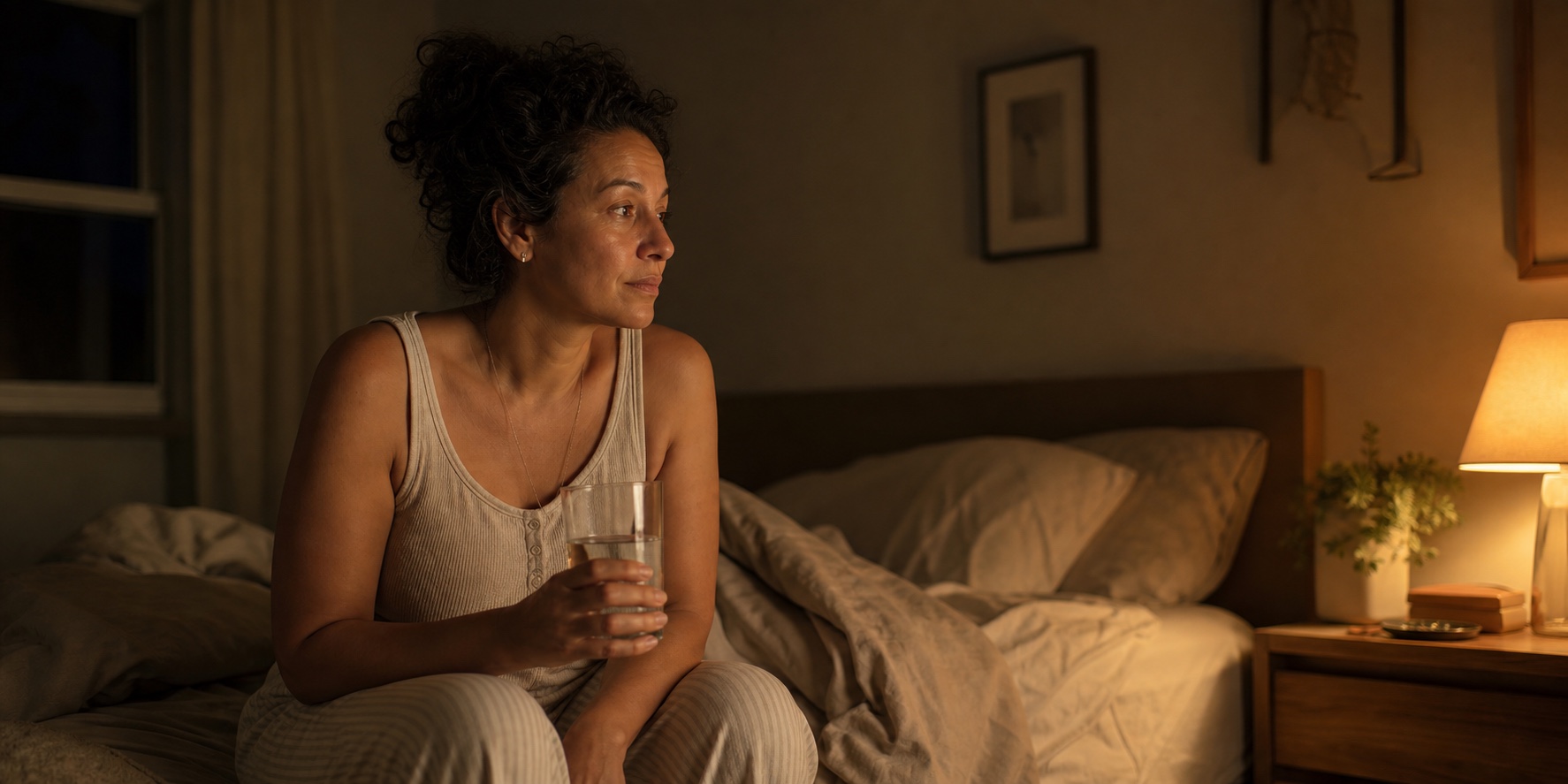
There is a special kind of fury in waking up at 3:17 a.m. with damp pajamas, cold sheets, and the sudden conviction that your bedroom has become a swamp.
You kick off the blankets. Then you’re freezing. You change your shirt. You flip the pillow. You lie there wide awake, doing the mental math on how many hours you have left before the alarm goes off.
And then, because your brain is apparently hosting a late-night medical symposium, you start wondering: Is this perimenopause? Is it stress? Is something actually wrong?
Let me be clear: perimenopause night sweats are real, common, and deeply annoying. They can disrupt your sleep, drain your energy, and make you feel like your body has lost the plot. But they’re also worth understanding carefully, because not every episode of waking up sweaty is automatically hormones.
You’re not imagining this. Your body may be changing. And you deserve better than “try lighter pajamas.”
What Counts as a Night Sweat?
People use “night sweats” to mean everything from “I got too warm under a duvet” to “I woke up drenched and had to change the sheets.” Those aren’t the same thing.
In medical language, night sweats usually mean repeated episodes of heavy sweating during sleep, often intense enough to soak sleepwear or bedding. Mayo Clinic notes that true night sweats are different from simply overheating because your room is too warm or your blankets are too heavy. They also flag that regular night sweats with symptoms like fever, weight loss, cough, diarrhea, or pain should be discussed with a healthcare professional.
That’s the line I want you to hold in your mind: hormones can absolutely cause night sweats, but hormones don’t get blamed for everything by default.
Perimenopause is a very plausible suspect, especially if you’re in your late 30s or 40s and you’re also noticing irregular periods, hot flashes, mood shifts, sleep problems, brain fog, or the sudden inability to tolerate polyester like a civilized person. But it is still worth paying attention to the pattern.
Quick check: Are you waking up sweaty because the room is hot, the bedding is heavy, or you drank wine close to bedtime? Or are you waking from an internal heat surge that feels like someone flipped a switch inside your chest?
That switch-flip feeling is the one many women describe with hormonal night sweats.
Why Perimenopause Can Make You Sweat at Night
Night sweats are basically hot flashes that happen while you’re asleep. The medical term is vasomotor symptoms, which is an unnecessarily fancy way of saying your blood vessels and temperature regulation system are getting involved.
Here’s the plain English version.
During perimenopause, estrogen and progesterone don’t decline in a neat, graceful line. They wobble. They surge. They drop. Mayo Clinic describes perimenopause as a time when estrogen rises and falls, and those shifts can bring hot flashes, sleep problems, and night sweats.
Your brain has a built-in thermostat, called the hypothalamus. It helps decide when you’re too hot or too cold. Research suggests that shifting estrogen levels can narrow your body’s comfort zone, so tiny temperature changes can trigger an oversized response. Your blood vessels widen. Your skin heats up. You sweat. Your heart may race. Then the sweat cools and suddenly you’re shivering in damp clothes.
Elegant? No. Biologically impressive? Unfortunately, yes.
The really unfair part is that perimenopause can affect sleep even when a hot flash doesn’t fully wake you up. Mayo Clinic notes that sleep changes can happen during perimenopause even without obvious hot flashes or night sweats. So you may be dealing with two problems at once: heat surges that wake you, and hormonal sleep disruption that makes it harder to fall back asleep once you’re awake.
That’s why the next day feels so brutal. It isn’t just the sweating. It’s the broken sleep.
What Perimenopause Night Sweats Can Feel Like
Women describe this in different ways, but the pattern often sounds like this:
- Waking suddenly with heat rising through the chest, neck, or face
- Damp or soaked pajamas, sheets, pillowcases, or hairline
- A racing heart or jittery feeling when you wake
- Feeling hot first, then chilled once the sweating passes
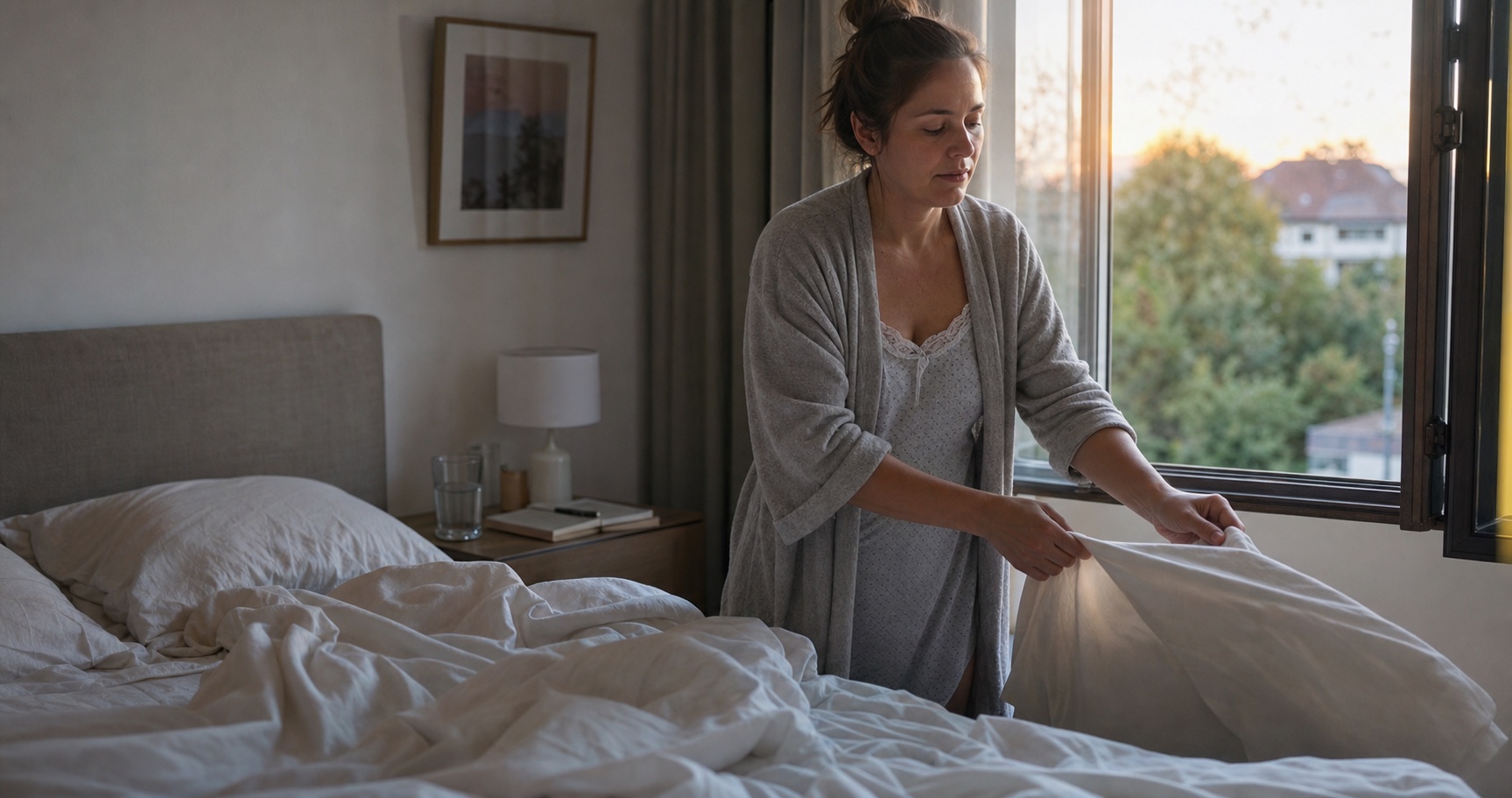
- Needing to change clothes, move to another room, or strip the bed
- Trouble falling back asleep because your body feels activated
- Next-day exhaustion, irritability, brain fog, or sugar/caffeine cravings
One woman I interviewed, “Melissa,” 44, told me she started keeping spare T-shirts beside the bed because getting up to find one woke her completely.
“It sounds dramatic until you’re doing laundry at 4 a.m. because your own body turned against your fitted sheet.”
Her doctor asked about stress. Fair question. She was stressed. She also had shorter cycles, new afternoon anxiety, heavier periods, and night sweats that arrived like clockwork the week before her period.
Stress was part of the picture. It wasn’t the whole picture.
That distinction matters.
The Triggers Nobody Warns You About
Hormones may be the underlying reason, but triggers can decide whether the night is mildly annoying or a full bedding incident.
Common triggers include:
- Alcohol, especially wine, close to bedtime
- Spicy food at dinner
- Caffeine later in the day
- A warm bedroom
- Heavy comforters or heat-trapping pajamas
- Evening stress spikes
- Intense late-night workouts
- Some medications
- Illness, infection, thyroid issues, or other medical conditions
This is where women get blamed unfairly. The conversation turns into “just avoid wine and spicy food,” as if you caused the entire hormonal transition with one glass of cabernet.
No.
Triggers are not moral failures. They’re clues. If alcohol makes your night sweats worse, that’s information you can use. If stress makes them worse, that’s information too. But reducing triggers is not the same as pretending the underlying hormone shift isn’t happening.
Here’s the thing: you can make the room cooler and still deserve medical help.
When Night Sweats Need a Medical Check
I don’t want this article to become a 2 a.m. panic machine. Most night sweats in midlife are not a medical emergency. But some patterns deserve prompt attention.
Talk with a healthcare provider if your night sweats:
- Happen regularly and disrupt your sleep
- Come with fever, chills, unexplained weight loss, cough, diarrhea, or persistent pain
- Start suddenly and severely without an obvious explanation
- Are paired with a new medication or medication change
- Happen after menopause, especially if you’ve also had bleeding
- Come with symptoms that make you feel unsafe, faint, short of breath, or unusually unwell
This isn’t fearmongering. It’s basic sorting.
Perimenopause can explain a lot. It should not become a junk drawer where every symptom gets tossed because you’re in your 40s. A good provider can help rule out thyroid problems, infection, medication effects, sleep apnea, and other causes while also taking hormonal symptoms seriously.
That last part matters. You don’t need a provider who says, “It’s probably hormones, live with it.” You need one who can say, “Hormones may be involved. Let’s look at the full picture and talk through options.”
What You Can Try Tonight
Let’s separate immediate comfort from actual treatment.
Immediate comfort won’t fix the hormonal engine underneath the night sweats. But it can reduce the damage to your sleep, and sleep is not a small thing. Sleep is the foundation holding the rest of your sanity together with tape and optimism.
Practical steps that may help:
- Keep your bedroom cool, and use layers you can remove quickly.
- Choose breathable cotton, linen, bamboo, or moisture-wicking sleepwear.
- Use a lighter blanket with an extra layer nearby instead of one heavy comforter.
- Keep water and a spare shirt beside the bed.
- Try a cooling pillow or a second pillow you can swap in.
- Note alcohol, spicy meals, caffeine, and stress patterns without turning it into a self-blame spreadsheet.
- If you’re waking often, track the timing in relation to your cycle.
That last one is surprisingly useful. Perimenopause symptoms can cluster around certain points in your cycle, especially when hormones are swinging. If your night sweats spike before your period, during missed periods, or alongside cycle changes, that pattern gives your provider better information than “I sweat at night sometimes.”

What to Discuss With Your Provider
This is the part where I put the medical boundary in big, clear letters: I’m not a doctor, and this article isn’t medical advice. The goal is to help you walk into the appointment with better language, not to tell you what treatment to choose.
You can say:
“I’m waking up with night sweats several times a week, and it’s affecting my sleep and daytime functioning. I’m also noticing [cycle changes / hot flashes / mood shifts / brain fog]. Could we talk about whether perimenopause might be involved and what else we should rule out?”
Helpful topics to ask about:
- Whether your pattern fits perimenopause or another cause
- Thyroid testing, medication review, infection screening, or other workup if appropriate
- Sleep quality and whether snoring or sleep apnea symptoms are present
- Hormone therapy, if you’re a candidate
- Nonhormonal prescription options for hot flashes and night sweats
- Lifestyle changes that are realistic for your life, not a fantasy version of your life with unlimited time and no children/pets/aging parents/email
ACOG says systemic estrogen therapy, with or without progestin depending on whether you have a uterus, is the most effective treatment for hot flashes and night sweats. The Menopause Society’s 2023 nonhormone therapy position statement also reviews evidence-based nonhormonal options, including certain medications and behavioral approaches, for people who can’t or don’t want to use hormone therapy.
Notice what I’m not saying: “You should take hormones.” That’s between you and a qualified clinician who knows your health history, risks, preferences, and symptoms.
What I am saying is this: you are allowed to ask about real treatment options.
The Sleep Problem Under the Sweat Problem
Night sweats are miserable on their own. But the bigger issue is often what they do to your sleep over weeks and months.
Broken sleep changes everything. Your mood gets sharper around the edges. Your brain feels slower. Your appetite cues get weird. Your patience shrinks. Small problems feel enormous because your nervous system has been running on interrupted nights and emergency caffeine.
Then you go to the doctor and say, “I’m anxious and exhausted.”
And if nobody asks about night sweats, cycle changes, or perimenopause, the whole story gets filed under stress.
This is how women get missed.
If you want a broader symptom map, I wrote about perimenopause fatigue and why exhaustion can become the symptom that finally sends women searching for answers. Night sweats often feed that fatigue. So do 3 a.m. wakeups, heavier periods, mood changes, and the quiet mental load of wondering what the hell is happening to you.
You’re not falling apart. Your sleep is being interrupted by a body in transition.
Those are different stories.
How to Track Night Sweats Without Becoming a Full-Time Data Scientist
You do not need a color-coded spreadsheet unless that genuinely delights you. Some of us are notebook people. Some of us are “type one sentence in the Notes app and hope for the best” people. Both count.
Track four things for two to four weeks:
- How often night sweats happen
- How intense they are, from mild dampness to changing clothes or sheets
- Where you are in your cycle, if you’re still having periods
- Possible triggers: alcohol, spicy food, stress, caffeine, illness, medication changes
Bring that to your appointment. It gives your provider something concrete to work with, and it helps you stop wondering whether you’re “making too much of it.”
You’re not.
And if you need a place to start, the free perimenopause symptom tracker was built for exactly this kind of pattern-spotting and doctor conversation prep.
The Bottom Line
Perimenopause night sweats are not just “being hot at night.” They can be a vasomotor symptom driven by hormonal changes, and they can seriously wreck your sleep.
They also deserve context. If they come with red-flag symptoms, get checked. If they’re disrupting your life, bring them up. If your provider shrugs, ask more specific questions or look for someone with menopause experience. The Menopause Society has a directory of menopause-informed practitioners, and for many women, finding a provider who actually understands this transition changes the whole conversation.
You don’t have to perform toughness while quietly laundering your sheets at dawn.
This is real. It has names. It has patterns. And you deserve care that treats it like something worth solving.
Want the bigger symptom map?
Not Crazy, Just Hormones walks through the symptoms, the science, and the provider scripts women need when their bodies start changing and nobody bothered to hand them a manual.
The information in this post is for educational purposes only and is not intended as medical advice. Always consult with a qualified healthcare provider about symptoms, diagnosis, and treatment decisions. Evelyn Cale is not a medical professional.
References
- Mayo Clinic. “Perimenopause: Symptoms and causes.” https://www.mayoclinic.org/diseases-conditions/perimenopause/symptoms-causes/syc-20354666
- Mayo Clinic. “Hot flashes: Symptoms and causes.” https://www.mayoclinic.org/diseases-conditions/hot-flashes/symptoms-causes/syc-20352790
- Mayo Clinic. “Night sweats: Causes.” https://www.mayoclinic.org/symptoms/night-sweats/basics/causes/sym-20050768
- American College of Obstetricians and Gynecologists. “Hormone Therapy for Menopause.” https://www.acog.org/womens-health/faqs/hormone-therapy-for-menopause
- The Menopause Society. “The 2023 Nonhormone Therapy Position Statement.” Menopause. 2023;30(6):573-590. https://pubmed.ncbi.nlm.nih.gov/37252752/
- The Menopause Society. “Night Sweats. What If It’s Not Menopause?” https://menopause.org/wp-content/uploads/for-women/MenoNote-Night-Sweats.pdf