
Perimenopause Joint Pain: Why Everything Suddenly Aches
Perimenopause joint pain can feel like your knees, hips, hands, or shoulders changed the rules overnight. Here's why hormones may be involved, what else to rule out, and what to track.
Perimenopause Joint Pain: Why Everything Suddenly Aches
One day your body is reasonably cooperative.
The next day your knees sound like cereal, your hips complain when you stand up, your hands feel stiff in the morning, and your shoulder has apparently filed a formal grievance.
If you are searching for perimenopause and joint pain, I am guessing something like this has happened: the aches feel new, scattered, and weirdly hard to explain. Not an obvious injury. Not a heroic athletic comeback. Just…everything hurts more than it used to.
You’re not imagining this.
Joint pain can have many causes, and some need medical attention. But perimenopause can absolutely be part of the conversation. Hormone shifts can affect inflammation, connective tissue, sleep, pain sensitivity, muscle strength, and the way your body recovers from ordinary life.
This article is educational, not medical advice. I am not a doctor. But I can help you sort the “could this be hormonal?” clues from the “please get this checked” clues, because your joints deserve more than a shrug and a bottle of ibuprofen from the back of the cabinet.
Can Perimenopause Cause Joint Pain?
It can contribute, yes.
The NHS lists perimenopause and menopause as possible causes of aching and painful joints because of lower estrogen levels. A 2024 review in Climacteric described musculoskeletal symptoms as common during the menopause transition and estimated that more than 70% of women experience some kind of musculoskeletal symptom during this period.
That does not mean every sore knee is perimenopause.
It means the old story was too small. For a long time, women were taught to look for hot flashes and skipped periods. If your ankles hurt, your fingers felt stiff, or your shoulder suddenly froze up, perimenopause rarely made the suspect list.
Here’s the thing: estrogen does not only affect periods. Estrogen receptors are found in muscle, bone, cartilage, ligaments, tendons, and other connective tissues. When estrogen fluctuates and eventually declines, some women notice more stiffness, aches, tendon irritation, or slower recovery.
Plain English: your joints may be responding to a changing internal environment.
Not dramatic. Biological.
What Perimenopause Joint Pain Can Feel Like
Joint pain during perimenopause does not always announce itself in one tidy way.
Women describe it as:
- Morning stiffness in the hands, hips, knees, ankles, or feet
- Aching that moves around from joint to joint
- Knees or hips that feel older than the rest of you
- Wrist, finger, or thumb pain that makes jars personally offensive
- Shoulder stiffness or pain, sometimes with reduced range of motion
- Tendon pain around elbows, heels, hips, or shoulders
- More soreness after exercise than you used to have
- A general “why do I feel like I slept in a suitcase?” body ache
One woman I interviewed, “Mara,” 46, told me she first noticed it on the stairs.
“I wasn’t injured. I hadn’t started a new workout. But every morning my knees hurt going downstairs, and my hands felt stiff when I made coffee. I remember thinking, am I suddenly 80? What happened?”
That question is the doorway for a lot of women.
Am I aging overnight? Did I miss an injury? Is this arthritis? Is it stress? Is this perimenopause? Why did nobody mention joints?
Good questions. All worth answering without panic.

Why Hormones May Affect Joints, Tendons, and Stiffness
The science is still evolving, but several pathways make sense.
Estrogen affects inflammation. When estrogen fluctuates, inflammatory signaling may shift too. For some women, that can feel like more aches, more stiffness, or more sensitivity after ordinary activity.
Connective tissue may change. Tendons, ligaments, fascia, and cartilage are not separate from the hormone story. They are living tissues. Hormone changes may affect collagen turnover, tissue hydration, and repair.
Sleep changes amplify pain. If perimenopause night sweats are waking you up, or anxiety is keeping your nervous system on high alert, pain can feel louder. Bad sleep is not a moral failure. It is a pain amplifier.
Muscle loss can sneak in. Midlife often brings changes in muscle mass, strength, and recovery. Less strength around a joint can mean more strain on the joint itself. This is one reason a provider, physical therapist, or qualified trainer may talk with you about strength work.
Other conditions can overlap. Arthritis, thyroid disease, autoimmune conditions, vitamin D deficiency, low iron, injury, medication effects, infection, and inflammatory conditions can all cause joint pain. Perimenopause may be part of the picture without being the whole picture.
That last sentence matters.
Hormones are not a trash can where every symptom gets thrown when nobody wants to investigate.
The Frozen Shoulder Question
Frozen shoulder, also called adhesive capsulitis, gets mentioned a lot in menopause circles right now.
It usually involves shoulder pain and stiffness that gradually limits range of motion. Reaching behind your back, putting on a jacket, fastening a bra, lifting your arm overhead, or sleeping on that side can become miserable.
Research is still catching up, but the connection is plausible enough to take seriously. A 2026 Climacteric pilot study looked at research design questions around hormone therapy and adhesive capsulitis, noting that frozen shoulder often affects women ages 40 to 60 and that hormonal factors may be worth studying more carefully.
Translation: this is not settled science, and nobody should diagnose you from a blog post. But if your shoulder suddenly loses motion during the perimenopause years, it is reasonable to bring up the timing and ask what should be evaluated.
Try:
“My shoulder pain and stiffness are new, and I am losing range of motion. I am also noticing possible perimenopause symptoms. Could this be adhesive capsulitis or something else, and what should we rule out?”
Specific. Calm. Harder to dismiss.
When Joint Pain Needs Medical Attention
This is where we keep the line bright.
Perimenopause can be involved in joint pain. It should not be used to wave away symptoms that need care.
The NHS advises seeing a GP when joint pain stops you from doing normal activities, affects sleep, gets worse, keeps coming back, does not improve after two weeks of home care, or comes with morning stiffness lasting more than 30 minutes.
Ask for urgent medical help if:
- The skin around the joint is swollen and feels hot
- You feel generally unwell, feverish, hot and cold, or shivery
- Pain is severe after a fall or injury
- You cannot walk or put weight on the joint
- The joint looks out of place
- You have tingling or loss of feeling after an injury
Also talk with a provider if pain is one-sided and sudden, paired with major swelling, associated with unexplained weight loss, comes with rash or eye symptoms, or is interfering with work, sleep, exercise, or basic daily life.
Not because you should panic.
Because “probably hormones” is not a diagnosis.
What to Track Before Your Appointment
You do not need a 47-tab spreadsheet with color coding and emotional footnotes.
You need patterns.
For two to four weeks, write down:
- Where it hurts: knees, hips, hands, wrists, shoulders, feet, jaw, back
- What it feels like: stiffness, ache, sharp pain, swelling, burning, weakness, reduced range of motion
- When it happens: morning, night, after sitting, after exercise, before your period, during bleeding, after poor sleep
- How long stiffness lasts: especially morning stiffness
- What else is changing: sleep, cycle length, bleeding, hot flashes, night sweats, anxiety, fatigue, brain fog, vaginal or urinary symptoms
- What changed recently: exercise, shoes, work setup, medication, supplements, illness, injury, stress, alcohol, caffeine
- What helps or worsens it: movement, rest, heat, cold, stretching, sleep, certain activities
If the joint pain is part of a bigger pattern, pair this with the complete perimenopause symptoms list or the perimenopause symptom tracker.
The goal is not to prove perimenopause in court.
The goal is to walk into the appointment with useful data instead of saying, “Everything hurts and I don’t know why,” while your provider stares at the clock.
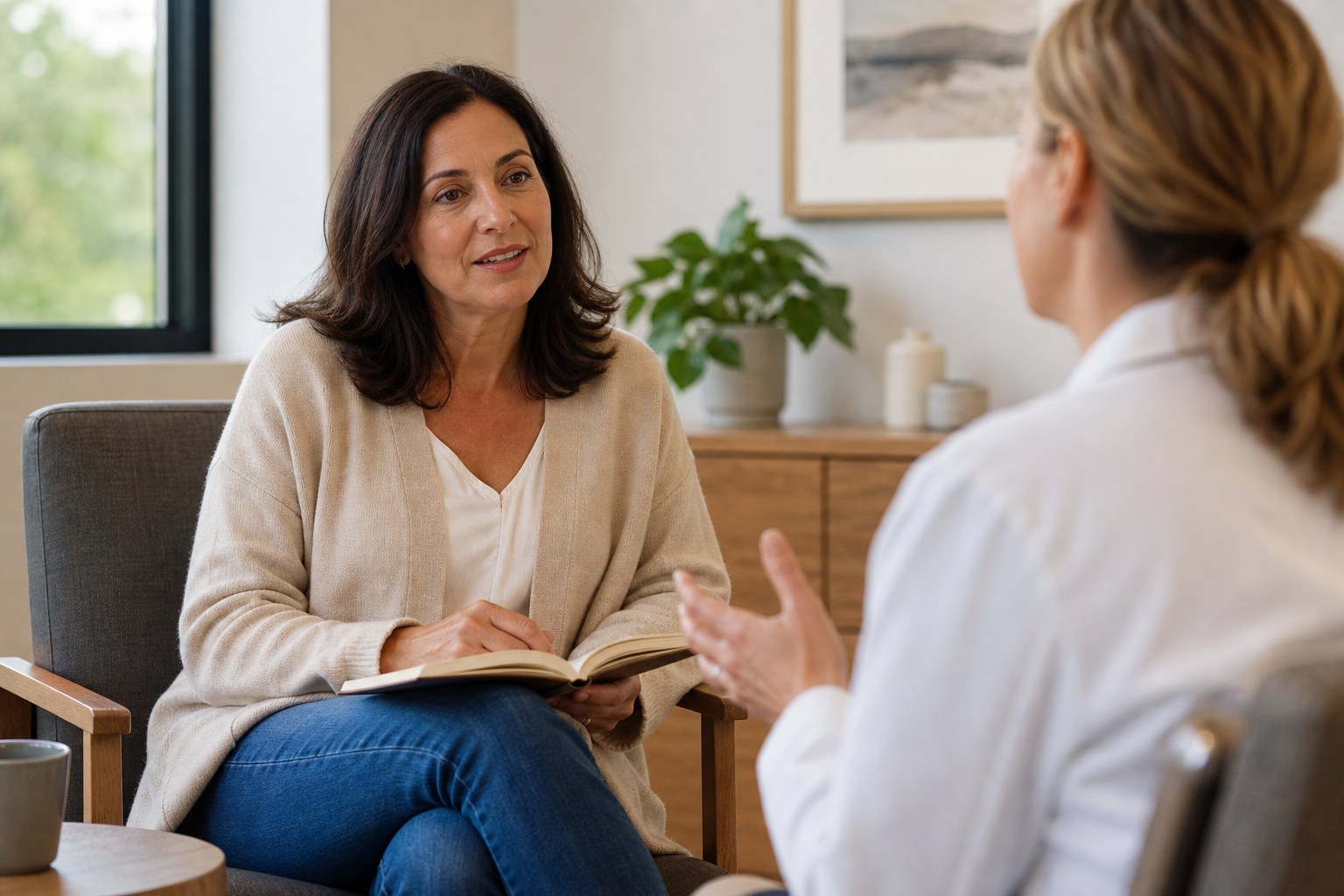
What to Say to Your Provider
Here is a script you can adapt:
“I have new or worsening joint pain in [locations]. It started around [timeframe], and I am also noticing [cycle changes/night sweats/sleep disruption/mood changes/other symptoms]. I know joint pain can have many causes. What should we rule out, and could perimenopause be contributing?”
Then ask:
- “Do my symptoms sound like arthritis, tendon irritation, frozen shoulder, an autoimmune issue, thyroid disease, injury, or something else?”
- “Are there red flags in my pattern?”
- “Would labs, imaging, physical therapy, or a specialist referral make sense?”
- “What movement is safe while we figure this out?”
- “At what point should I seek urgent care?”
Notice what you are doing here. You are not demanding a hormone label. You are asking for a thoughtful differential.
That is reasonable care.
What May Help Depends on the Cause
I am going to resist the internet’s favorite move, which is pretending every symptom has one tidy fix.
Joint pain does not.
If the cause is inflammatory arthritis, that needs one kind of care. If it is frozen shoulder, that may need physical therapy or other provider-guided treatment. If thyroid disease or vitamin deficiency is involved, that is another lane. If sleep loss and hormone swings are amplifying ordinary aches, the conversation may include menopause-informed care, strength training, pain management, and sleep support.
The point is not to self-treat your way through mystery pain.
The point is to get the right explanation.
In the meantime, gentle movement, strength work, sleep support, ergonomic changes, and pacing activity may come up in a provider or physical therapy conversation. Please hear the framing: may come up. Discuss what is appropriate for your body, your medical history, and your actual diagnosis.
You are not lazy because your joints hurt.
You are not failing midlife because your body needs different support than it did at 32.
The Bottom Line on Perimenopause and Joint Pain
Perimenopause joint pain can be real. It can feel like stiffness, aching, tendon pain, shoulder trouble, or soreness that seems to arrive without a clear injury. Hormone shifts may contribute through inflammation, connective tissue changes, sleep disruption, pain sensitivity, and muscle changes.
And still, joint pain deserves a real medical look when it is new, persistent, worsening, swollen, hot, limiting motion, affecting sleep, or interfering with daily life.
Both things can be true.
Your body is not being ridiculous. It is giving you information. Track the pattern, know the red flags, and ask for a provider who can look at the whole picture instead of treating each symptom like a random inconvenience.
You deserve better than “welcome to getting older.”
Trying to sort the symptom pile?
Start with the complete perimenopause symptoms list, then use the symptom checklist to organize what is changing before your next appointment. For the bigger map, read Not Crazy, Just Hormones.
References
- Wright VJ, Schwartzman JD, Wittstein J. “The musculoskeletal syndrome of menopause.” Climacteric. 2024. PubMed PMID: 39077777.
- NHS. “Joint pain.” Last reviewed 2026. https://www.nhs.uk/symptoms/joint-pain/.
- Reinke EK, Ford AC, Wahl E, Kennedy J, Poehlein E, Green CL, Saltzman E, Wittstein JR. “A preliminary pilot study to address design issues related to research on potential association of hormone therapy and adhesive capsulitis.” Climacteric. 2026. PubMed PMID: 41614260.
A reminder: this article is for education only and is not medical advice. Evelyn Cale is not a doctor. Please work with a qualified healthcare provider for diagnosis, treatment decisions, or symptoms that are new, severe, persistent, or concerning.