
Strength Training During Perimenopause: Why Muscle Matters Now
Strength training during perimenopause can support muscle, bone health, and daily function without turning your life into a punishing exercise plan.
You used to be able to skip a few workouts and carry on. Now one bad night of sleep, one weirdly angry knee, and a week where everyone in your house needs something from you can make exercise feel like a personal insult.
Then the internet says strength training during perimenopause is the answer to everything. Your weight. Your mood. Your bones. Your future. Your apparently inadequate collection of matching leggings.
Take a breath.
Short answer: strength work can support muscle, strength, bone health, and everyday function. But the clearest research comes from general adult and postmenopausal groups, not from large perimenopause-specific trials. It is a useful option to discuss and try in a way that fits you, not a moral requirement, a punishment for having a changing body, or proof that you have failed if the scale does not immediately become grateful.
Why muscle matters more in midlife
Here is the thing: muscle is not just there to make a grocery bag feel lighter or a suitcase less humiliating. It helps you move, climb stairs, get up from the floor, protect joints, and keep doing the ordinary things that make up a life.
As we age, muscle mass and strength can decline. The NICE evidence review notes that strength decline is also associated with aging and lower activity. The menopause transition can arrive at the same time as sleep loss, caregiving, work stress, injuries, less time to move, and a body that may recover differently than it did at 27. No wonder a workout that once felt routine can suddenly feel like a negotiation.
The NICE menopause guideline includes physical activity in its broader menopause guidance. General adult guidance from ACOG also describes muscle-strengthening activity as a way to build muscle and slow bone loss. That is a better frame than “fix your body before it gets away from you.” Muscle is useful. Strength is useful. The rest is marketing noise.
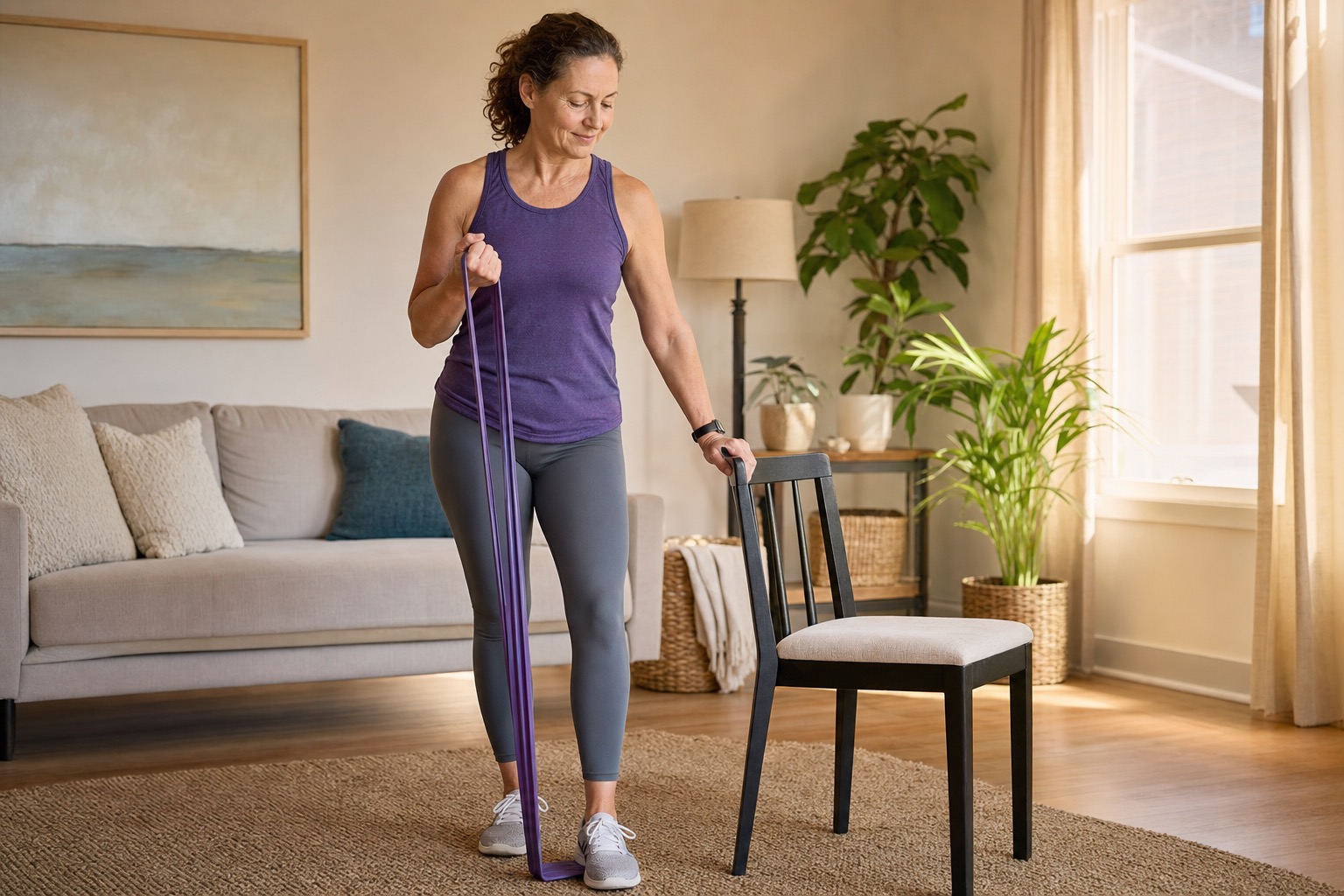
And no, you do not need to become someone who calls a barbell her best friend. Resistance can come from body weight, bands, machines, free weights, or a carefully designed program with a qualified professional. The right starting point depends on your health, injuries, access, experience, and what you will actually keep doing.
Strength training and perimenopause weight gain are not the same conversation
Many women find this topic because their body composition has changed and they want an explanation that is not “try harder.” Fair.
The Mayo Clinic notes that weight changes around menopause have more than one cause, including aging, changes in muscle mass, lifestyle, genetics, and shifts in where the body stores fat. Sleep disruption and a full life do not exactly make that easier.
Strength training can support muscle and general health. It may also be part of a broader approach to physical activity. But it does not promise a particular body size, erase perimenopause, or cancel out every other factor affecting weight. Anyone selling that promise is trying to sell you something, and it is probably not peace.
If body changes are upsetting or feel sudden, bring the full picture to your provider: cycle changes, sleep, appetite, medications, stress, pain, energy, and any other symptoms. You deserve an actual conversation, not a shrug and a step-counting app.
For a kinder way to sort through the body-change part, read perimenopause bloating vs. weight gain. It separates changes that fluctuate from changes that persist, without treating your body like a failed project.
What a reasonable starting point can look like
Let me be clear: I am not handing you a personal exercise plan from the internet. Your starting point should fit your body and your real life.
The CDC’s general adult guidance includes muscle-strengthening activity alongside aerobic movement. That is population guidance, not a perimenopause workout prescription or a command to ignore pain, jump into a hard class, or copy the workout of a stranger with an extremely aggressive ponytail. The CDC also emphasizes choosing activities that match your abilities and talking with a clinician about activity when a chronic condition affects the decision.
For many people, a sensible beginning means keeping the barrier low:
- Choose a form of resistance that feels approachable, such as bands, body weight, machines, or light free weights.
- Focus on learning movement comfortably rather than proving how hard you can go.
- Leave room for recovery, especially if sleep has been a disaster lately.
- Build consistency before intensity. Boring, perhaps. Effective, often.
- Ask for coaching if technique feels confusing or a previous injury is making you nervous.
If equipment choice is the part that has you stuck, see resistance bands versus weights during perimenopause. It can help you think through the practical tradeoffs before you buy anything.
That last point is not weakness. Good instruction is a shortcut around the part where you accidentally turn a wellness goal into a back-pain origin story.
When to get individualized guidance first
Exercise is not all-or-nothing. But a new program may need a more careful conversation if you have a recent injury or surgery, significant joint pain, osteoporosis or a history of fractures, a heart or lung condition, dizziness, chest symptoms, or a condition that affects balance or movement.
Talk with your healthcare provider about what is appropriate for you. A physical therapist, qualified exercise professional, or clinician who understands your history may also help you find a starting point that is safer and less miserable.
And if pain appears during activity, gets worse, or changes how you move, do not turn grit into a treatment plan. Pause and get it assessed. If joint pain has become part of your perimenopause picture, our guide to perimenopause joint pain can help you prepare better questions for that appointment.
Your recovery still counts
Perimenopause advice can get weirdly intense. More protein. More steps. More lifting. More discipline. More tracking. Soon you need a second job just to maintain the first job of being a human.
But training is only one piece of the week. Sleep, stress, food access, caregiving, illness, pain, medications, and time all shape what movement feels possible. A hard session that leaves you wrecked for four days is not automatically more virtuous than a manageable session you can repeat.
Some women find that they need to change the timing, type, or amount of activity they once enjoyed. Others keep doing what they have always done. Both are normal. Research in postmenopausal groups suggests resistance training can support strength and bone outcomes, but that does not automatically tell us what will happen during perimenopause. A 2025 systematic review found only six relevant trials across perimenopause and early postmenopause, with low-quality evidence and a high risk of bias. In its perimenopause subgroup, it did not find clear improvements in bone density or lean mass. Read the review on PubMed. That is a useful reason to skip the grand promises and focus on a sustainable, individualized conversation instead.
You are not lazy because your recovery needs changed. You are gathering information.
Questions to bring to your provider or trainer
If you want to add strength work but do not know where to begin, you can ask for help without handing over your agency. Try questions like:
- “I want to maintain strength and support my bone health during perimenopause. Are there reasons I should modify how I start?”
- “I have noticed this pain, old injury, or dizziness. What should be evaluated before I change my exercise routine?”
- “Would a physical therapist or qualified trainer be a good fit for my situation?”
- “What signs would mean I should stop and contact you?”
- “Can we talk about my sleep, energy, and body changes in context instead of only focusing on my weight?”
That is advocacy. Not showing up with a diagnosis. Not demanding a specific prescription. Just making sure the plan fits the person who has to live with it.
Make strength a support, not another rule
The best exercise plan is not the most punishing one or the one that performs best online. It is the one that respects your body, your schedule, and the fact that perimenopause may be asking more of you already.
Strength training during perimenopause can be valuable because muscle and bone health matter, because daily life feels better when you feel capable, and because there is something satisfying about carrying your own suitcase without negotiating with a stranger at baggage claim.
But it is not a cure. It is not a character test. And it is not the only thing worth talking about when your body feels unfamiliar.
If you want the bigger picture on symptoms, body changes, and getting taken seriously in medical appointments, Not Crazy, Just Hormones puts the research and the provider-conversation scripts in one no-BS place. You can also start with the free chapter.
The information in this post is for educational purposes only and is not medical advice. Talk with a qualified healthcare provider before changing your activity routine if you have symptoms, injuries, chronic health conditions, or other concerns. Evelyn Cale is not a medical professional.
References
- National Institute for Health and Care Excellence. Menopause: identification and management (NG23).
- National Institute for Health and Care Excellence. Menopause: identification and management, full guideline evidence review.
- American College of Obstetricians and Gynecologists. Staying Active: Physical Activity and Exercise.
- Centers for Disease Control and Prevention. Adding Physical Activity as an Adult.
- Mayo Clinic. The reality of menopause weight gain.
- Whitman, K. et al. Does exercising during peri- or early post-menopause prevent bone and muscle loss? A systematic review. Bone. 2025.