
Walking and Strength Training During Perimenopause: How They Fit Together
Walking and strength training can serve different purposes during perimenopause. Use this practical worksheet to prepare a personal activity conversation without a punishing routine.
Walking gets treated like it has become the wrong answer the minute you hit perimenopause. Then strength training arrives online with a cape, a sales funnel, and the quiet suggestion that you need to rebuild your whole personality around a gym.
No.
Walking and strength work can have different jobs. You do not have to declare one the winner. And you do not need a punishing plan to have a useful conversation about what fits your body and your actual week.
Here is the thing: familiar movement is not a failure. It is information. If walking is what you enjoy, can afford, or can make time for, that matters. If you are curious about adding muscle-strengthening activity, that can be a separate question. Not a referendum on whether you have tried hard enough.
Two categories, not two competing teams
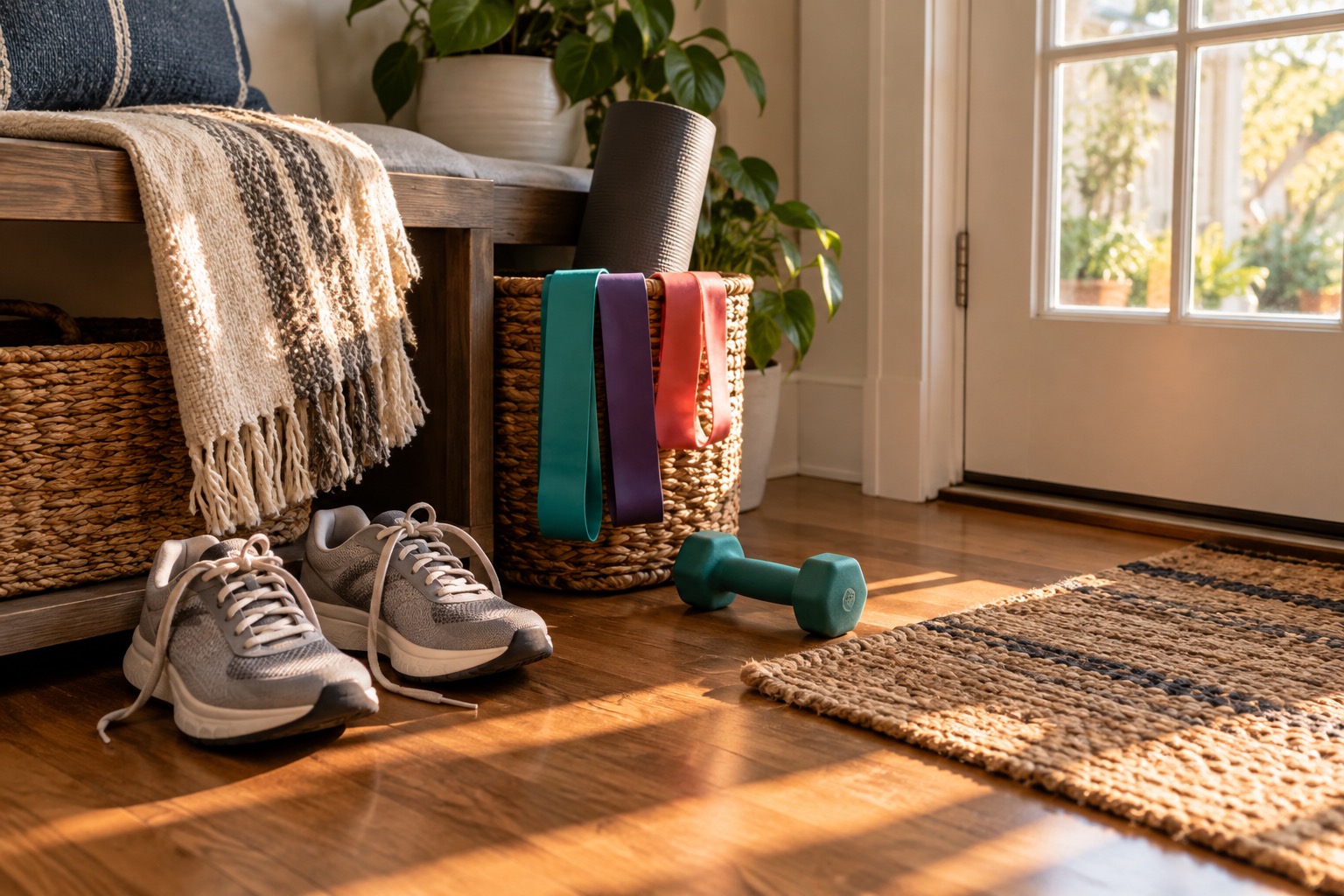
Public-health guidance separates aerobic activity from muscle-strengthening activity. Aerobic activity gets your heart and breathing working harder. A walk can count when its effort reaches the relevant intensity. Muscle-strengthening activity asks muscles to work against resistance, which can include weights, resistance bands, body weight, heavy gardening, or some hill walking and stair climbing. Activities can overlap. Bodies are not filing cabinets. CDC explains the adult activity categories, and the NHS gives everyday examples of muscle-strengthening activity.
That distinction is useful because it lets you ask a better question than, “Is walking enough?”
Try this instead: “What do I already like doing, and what might I want to explore if it feels appropriate for me?”
Walking can be a valued aerobic activity. Strength work may be something you want to discuss for muscle strength, bone health, balance, or daily tasks. Neither fact means walking is useless. Neither fact means you must buy a barbell before Tuesday.
If the equipment question is the part making your head spin, our guide to resistance bands versus weights during perimenopause explains the practical tradeoffs without declaring a universal winner.
What this does and does not say about perimenopause
Perimenopause can arrive while sleep changes, stress, old injuries, caregiving, work, and time pressure are all having their own loud opinions. That does not make movement irrelevant. It does mean a general-adult activity guide cannot tell you what will change a specific symptom, prevent every body change, or suit your health history.
The NHS includes regular exercise, strength-focused movement, weight-bearing activity such as walking, and resistance exercise in its general information about menopause and perimenopause. It does not turn any of them into a cure. See the NHS menopause and perimenopause guidance.
That limit matters. A routine that worked for a stranger on the internet is not a medical assessment, and it is not proof you should push through pain, dizziness, chest symptoms, or a change that worries you. Talk with a qualified healthcare provider before making a meaningful change in activity if you have a chronic condition, an injury, or concerns about what is safe for you. The CDC also advises this conversation for people with chronic health conditions and before vigorous activity in some situations. CDC: when to check with your doctor.
For the broader question of why strength is getting so much attention, read strength training during perimenopause. It keeps the evidence limits in view and skips the magical-thinking nonsense.
A week-observation worksheet, not a test
You do not need to track every breath you take. But a few plain notes can make a conversation with a provider, physical therapist, or qualified exercise professional more specific.
This is not a scorecard. It cannot diagnose a symptom, prove that an activity caused a problem, or tell you to delay care for something concerning. It is just a way to notice your real constraints before someone hands you a plan designed for a woman with far more free time and fewer laundry baskets.
For one ordinary week, make a small note when it is useful:
| Notice | Your note |
|---|---|
| Movement I did or considered | What it was, in your own words |
| What made it easier or harder | Time, cost, weather, company, pain, sleep, confidence, access, or something else |
| What I enjoyed or did not enjoy | No gold stars required |
| What changed how I felt able to move | A factual note, not a diagnosis |
| Question I want to ask | For example: “What should I consider before I add resistance work with my old knee injury?” |
A hypothetical example: Maya notices that she enjoys walking with a friend after work but keeps putting off an unfamiliar class because the schedule changes every week. Her useful question is not, “Why can I not make myself do more?” It is, “What kind of support or options would fit the activity I already enjoy and the limits I actually have?”
That is a much kinder starting point. And kinder plans tend to survive contact with real life.

Bring the whole picture to the conversation
If you want individual guidance, bring the parts that affect the decision: what movement you enjoy, what gets in the way, any pain or previous injury, your sleep, other health conditions, and what you hope activity might support. You are not asking for permission to be a person with limits. You are giving a qualified professional enough context to help safely.
You can ask:
- “I like walking and am curious about strength work. Are there reasons I should change how I start?”
- “I have noticed this pain, dizziness, or old injury. What should be assessed before I change my activity?”
- “Would a physical therapist or qualified exercise professional be useful for my situation?”
- “Can we talk about sleep, energy, and my other symptoms in context, rather than treating movement as a cure-all?”
If sleep is the part that is making every activity feel impossible, these questions about perimenopause sleep remedies can help you prepare that separate provider conversation. You do not have to solve every problem with one walk. Or one workout.
Keep the goal human-sized
The point is not to replace walking with strength work, or strength work with walking. The point is to understand what each category can mean, notice what is realistic, and get personal advice when you need it.
Your body is not a project that failed because it has needs. It is your body. It deserves a plan that makes room for your life.
If you want more practical provider-conversation scripts for perimenopause, start with the free chapter from Not Crazy, Just Hormones.
The information in this post is for educational purposes only and is not medical advice or an individual exercise plan. Talk with a qualified healthcare provider before changing your activity routine if you have symptoms, injuries, chronic health conditions, or other concerns. Evelyn Cale is not a medical professional.
References
- Centers for Disease Control and Prevention. Adding Physical Activity as an Adult. Accessed September 17, 2026.
- NHS. How to improve your strength and flexibility. Accessed September 17, 2026.
- NHS. Things you can do to help menopause and perimenopause symptoms. Accessed September 17, 2026.